

Endangered plant species in the Southern Bug enclave (Ukraine): genetics, evolutionary history and biogeography 2024-2026
Kolomiiets Ganna, Bartish Igor
Сrystalic outcrops in the Southern Bug River basin are one of Eurasia’s oldest landmasses. There, one can observe bedrock as old as over three billion years because rivers cutting through later sedimentary deposits have uncovered ancient granites of the Ukrainian tectonic shield. Millions of years ago, this area made up the coast of the warm Sarmatian Sea. Owed to the geological history and complex relief, the region, with an area of 50 sq. km became home to more than 1,000 species of wild plants, including endemics and relics.
The S. Bug granite flora is possibly connected to Ancient Mediterranean as one of the centres of floristic diversity because a group of plant species with disjunctive home ranges is distributed in the Bug region and in the Balkans. The Balkan region has been suggested to represent a centre of low-altitude postglacial speciation. Probably, in ancient times there were routes of floristic migration which are now interrupted because of ancient climatic changes, such as Quaternary glaciations. The ranges of rare and threatened species are currently decreasing due to recent climate change and anthropogenic transformations. Conservation of these species requires a detailed knowledge of genetic diversity within populations, evolutionary history, and biogeography of the species.
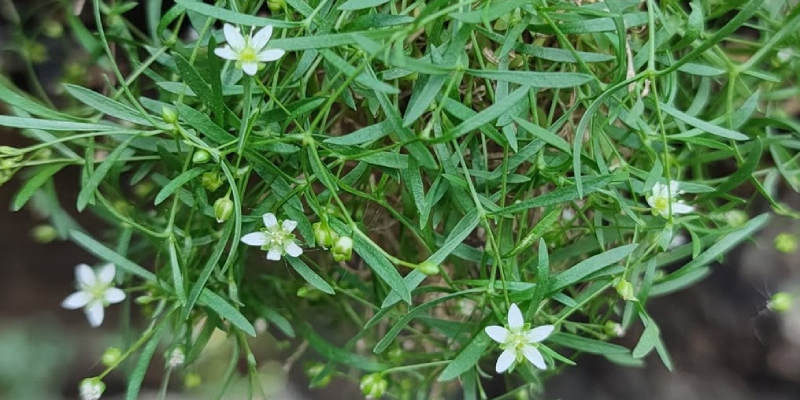
Moehringia hypanica Grynj et Klokov (Caryophyllaceae) is the rarest and most threatened plant species of S. Bug’s outcrops. It has only three populations in the world, all located on rocks of the S. Bug, the complete range is 25 sq. km, and the overall number of plants is around five thousand individuals. Although the species is listed in Resolution 6 of the Bern Convention, little is known about it due to its local distribution. Its IUCN status is Vulnerable, while the species is critically endangered because its populations are declining, and the cultivation in the open ground was unsuccessful.
We are studying the phylogeography of M. hypanica and other species of the genus that are found in the Balkans – both endemic and with a wider range.
Potentially low genetic diversity of populations of M. hypanica might lead to the decline of the adaptive potential of these populations, which could be the main driver of its likely extinction. We will estimate and compare genetic diversity within all populations of this local endemic species and within representative samples of populations of its closest relatives from the Balkans.
Knowledge of the extent of genetic diversity in each of the endangered populations and in populations of their closest relatives will serve as guidance for the improvement of the adaptive potential of endangered populations. Specifically, approaches such as evolutionary rescue, genetic restoration, and assisted gene flow could be used for the efficient preservation of these populations.
This project was funded under the EMBO Solidarity Grants (Supporting life scientists displaced by armed conflicts, the name of the project Endangered plant species in the Southern Bug enclave (Ukraine): genetics, evolutionary history and biogeography, the grant number is (SLG). -5449) – in 2024, and under the Researchers at Risk Fellowship 2024 (Czech Academy of Sciences) – in 2025.